49 Free Tools to Deploy Social Proof Examples Fast for Marketers
49 Free Tools to Deploy Social Proof Examples Fast for Marketers

Social proof is evidence that other people have bought, used, or publicly endorsed your offer, and it works because uncertain buyers copy the visible choices of others. The proof types with the biggest lift are customer reviews, user-generated photos, and popularity signals like best-seller badges. If you do nothing else this week, add one visible proof element to your top product page and A/B test it against the version without it.
TL;DR:
- Showing a visible star rating or review count near the price can increase trust, especially on high-traffic product pages.
- Customer photos, testimonials, or short case studies create a human connection that persuades uncertain buyers.
- Popularity signals like best-seller badges and live counters boost credibility and influence category-level choices.
- For new pages, prioritize adding reviews or testimonials first and avoid fake counters or fabricated numbers to stay compliant.
- Use simple tools like Zyff to embed reviews, popups, and testimonials easily without requiring developer resources.
Table of Contents
- Why social proof works on uncertain buyers
- Social proof examples organized by type
- How to add social proof in a week
- Measuring whether your social proof actually converts
- Matching Zyff’s widgets to each proof type
- Where to find social proof that is real, not manufactured
- Tailoring proof to your audience and industry
- What to prioritize first if you are starting from zero
- Try Zyff’s widgets before you build anything custom
- Sources
- FAQ
Why social proof works on uncertain buyers
Social proof taps into the bandwagon effect: when people are unsure what to choose, they look at what others are choosing and copy it. This is not a character flaw, it is a shortcut the brain uses to avoid a bad decision when the “right” answer is not obvious.
Research on decision-making backs this up. Making it salient that other people are also evaluating the same choice, through a live counter or an “others are viewing this” label, moderates judgment extremity and nudges undecided shoppers toward group consensus. A separate line of experiments found that social proof nudges carry the most weight when a person has no clear prior preference, and that the resulting lift is typically small but consistent rather than dramatic.
Social proof has the strongest effect on ambiguous, high-stakes-feeling choices, according to controlled nudge studies: a first-time buyer picking between two similar products, or someone comparing unfamiliar brands, is far more persuadable than someone who already knows exactly what they want.
Social proof examples organized by type
Each proof type below works differently, so treat them as a toolkit rather than a checklist to complete all at once.
Reviews and star ratings are the baseline. Show the average rating and review count near the price on product pages, and moderate for spam and duplicate content before publishing. Industry retail guides recommend enabling product reviews as one of the fastest, highest-impact tactics available to online sellers.
Testimonial and photo pairs work the best short. One sentence, a first name, a role or location, and a real photo beat a long paragraph every time: “This cut our onboarding time in half, Maria, Operations Manager.”
UGC galleries and tagged posts turn customer photos into a trust asset. Ask buyers to tag your handle in a post-purchase email, then curate a rotating gallery on the product or landing page rather than dumping every submission in.

Popularity signals like “Best Seller” or “Most Loved This Month” badges borrow the crowd’s judgment without needing a quote from anyone. They work especially well on category pages where shoppers are comparing several similar items.
Live activity counters and recent-purchase popups show real-time behavior: “12 people bought this in the last 24 hours” or “Someone in Ohio just purchased this.” Keep the cadence realistic. A popup firing every three seconds reads as fake and erodes the trust it was meant to build.
Expert badges, certifications, and press mentions belong near the point of decision, usually just below the headline or price, not buried in a footer.
Influencer endorsements need a visible, unambiguous disclosure such as “#ad” or “Paid partnership” placed where a viewer cannot miss it, in line with FTC guidance on endorsement disclosures.
Case studies with measurable outcomes work for B2B buyers who need a business case, not just a good feeling: a named company, a specific result, and the timeframe it took.
Follower counts and press logo strips build top-of-funnel credibility fast. A row of recognizable outlet logos or a follower count near your header signals you are an established, ongoing operation.
Before-and-after and mashup testimonial blocks give visual proof for categories like fitness, beauty, or home improvement, where the transformation itself is the pitch.
- Reviews and star ratings anchor trust on product and pricing pages.
- UGC and testimonial photos add a human face to the claim.
- Popularity badges and live counters borrow the crowd’s judgment for undecided shoppers.
- Press logos and follower counts establish credibility before a visitor even reaches your offer.
Pro Tip: Pair one quantitative proof (a rating or counter) with one qualitative proof (a testimonial or photo) on the same page, since they persuade different types of skeptics.
How to add social proof in a week
Getting proof live does not require a developer, but it does require a sequence.
- Pick your highest-traffic product or landing page and choose one proof type that matches its biggest objection, whether that is trust, quality, or popularity.
- Collect material through a post-purchase email asking for a review or photo, and clearly state any incentive rules if you offer one.
- Write and design with specifics: a real name, a real role, a real photo, and a quote that names a concrete result rather than a vague superlative like “amazing.”
- Ship the technical piece: embed a review widget, install a testimonial carousel, or add a recent-activity popup. Zyff’s answers hub walks through display and moderation options for reviews and star ratings.
- Run a compliance check: disclose paid endorsements clearly, never fabricate counters or review counts, and document consent for any UGC you repost.
Pro Tip: Never invent a review count or a “247 people bought this today” figure. The FTC’s rule on fake indicators of social influence treats manufactured proof as a legal liability, not just a marketing risk.
Measuring whether your social proof actually converts
Track conversion rate, checkout completion, and average order value as your primary signals, since these tie directly to revenue. Secondary metrics like clicks into the reviews tab or UGC gallery engagement tell you whether people are actually noticing the proof before they buy.
Run structured A/B tests rather than guessing:
- Ratings visible near the price versus ratings hidden or removed.
- A testimonial block present versus absent on the same landing page.
- A live purchase counter versus a static “Best Seller” badge.
Nudge-based lifts from social proof are usually small but real, according to controlled experiments on social-proof responsiveness, so plan for a test long enough and with enough traffic to detect a modest difference rather than expecting a dramatic swing after a day or two.
Matching Zyff’s widgets to each proof type
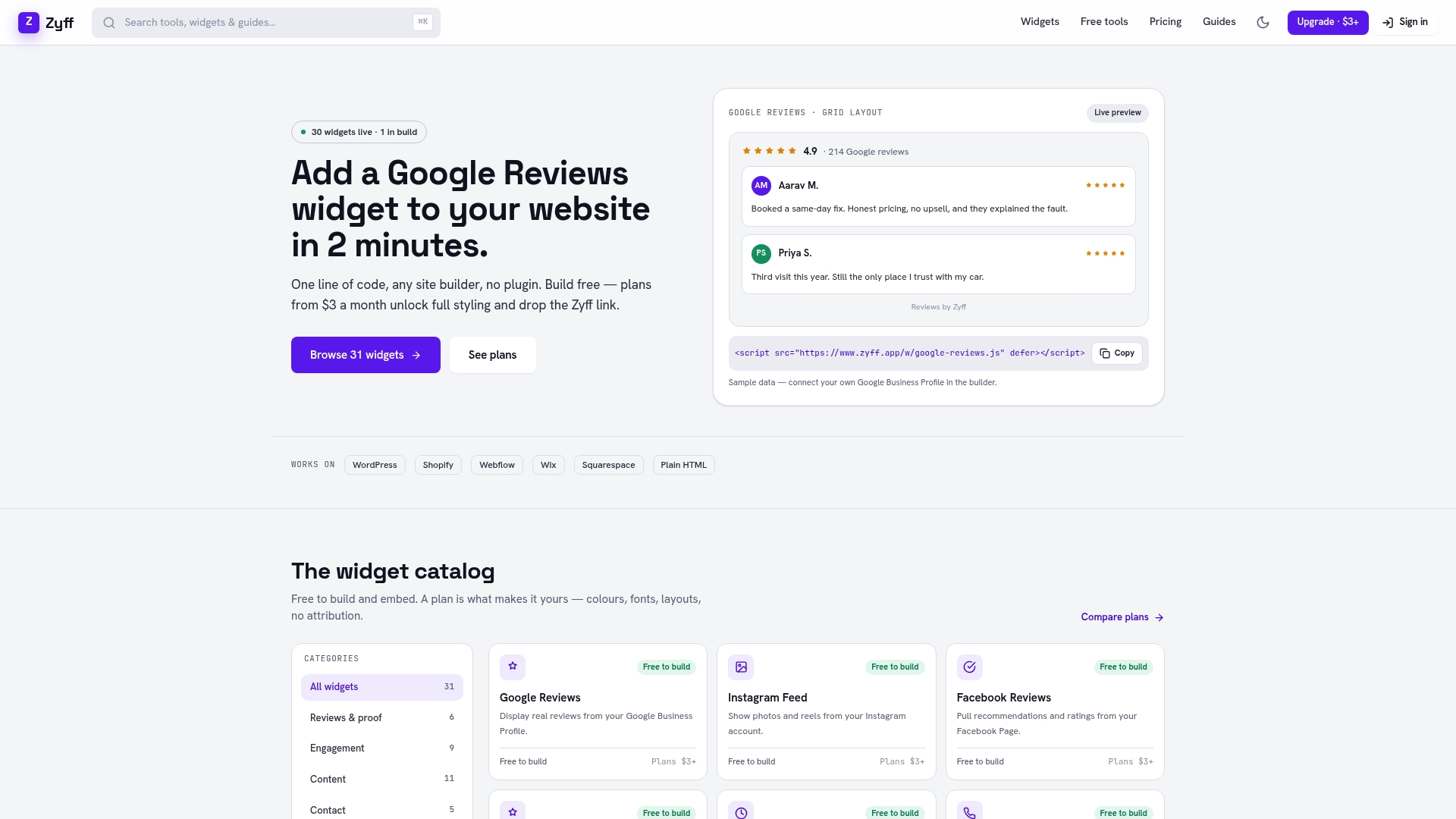
Zyff maps directly onto the examples above without requiring a developer. The Google reviews widget and Facebook reviews widget handle star ratings on product pages, a popup widget covers recent-activity signals, and share buttons surface wisdom-of-friends signals when visitors share a page.
- Reviews widgets pull Google and Facebook ratings onto any product page with one line of code.
- A popup widget covers recent-purchase and limited-stock style notifications.
- Social share buttons extend wisdom-of-friends proof by making sharing visible and easy.
- A slider or carousel widget rotates testimonials without needing custom design work.
Every widget installs with a single line of code on any site builder, and free tiers often let small teams test placement before committing to a paid plan.
Where to find social proof that is real, not manufactured
The best proof comes from people who already bought, not from incentivized strangers writing on demand. Start with your existing customer list: a short post-purchase email asking “how did this help you?” produces more usable quotes than a generic review request.
For UGC, run a low-friction ask, like tagging your account for a chance to be featured, rather than requiring a long-form review. Photos and short captions convert better into gallery content than paragraphs of text anyway.
If you use incentives, disclose them and keep the bar low enough that people are not writing glowing reviews just to earn a reward; a $5 discount for an honest review, positive or negative, produces more credible proof than a contest tied to five-star ratings only.
Case studies deserve more effort than a quote pull. A short call with a customer who got a specific, describable result, and permission to publish their name and company, is worth more than a dozen generic testimonials.
Aggregated review platforms like G2 or Trustpilot add a layer of verified-buyer credibility that your own site cannot replicate alone, since visitors trust a third party’s moderation more than your own. Point to those profiles rather than trying to recreate their verification badges yourself.
Avoid the temptation to reuse the same three testimonials across every page. Stale proof, especially with visible old dates, signals a business that has not grown or improved recently, which undercuts the very trust you are trying to build.
Tailoring proof to your audience and industry
A B2C shopper buying a $30 product needs speed and reassurance: a star rating, a photo, and a popularity badge are usually enough to push past hesitation. A B2B buyer evaluating a five-figure contract needs a case study with a named company and a measurable result, because their decision has to survive a budget conversation with someone else.
Industry matters too. Fitness, beauty, and home improvement brands benefit most from before-and-after visuals, since the transformation is the product. SaaS and service businesses do better with outcome-based testimonials, tying a customer quote to a specific metric like reduced onboarding time or fewer support tickets, a pattern SaaS-focused writeups on reducing churn point to repeatedly.
Younger, mobile-first audiences respond well to UGC and influencer content because it mirrors what they already see on social feeds. Older or more risk-averse audiences, and regulated industries like finance or healthcare, tend to trust certifications, press mentions, and expert endorsements more than casual customer photos.
Local and service-based businesses should lean on Google reviews specifically, since that platform carries default credibility for anyone searching by location. E-commerce brands with a wide catalog benefit most from popularity signals at the category level, since “Most Loved” badges help shoppers narrow a large set of similar options fast.
The rule of thumb: match the proof’s format to how your buyer already makes decisions elsewhere in their life, not to whatever is easiest for you to collect.

What to prioritize first if you are starting from zero
Put proof on your highest-traffic product pages and checkout flow before anywhere else, since that is where doubt costs you the most. Skip fake counters and stale quotes entirely, refresh testimonials regularly, and treat a 30/60/90 rollout (reviews first, then UGC, then case studies) as a realistic pace for a small team.
— Ashok
Try Zyff’s widgets before you build anything custom
Zyff gives every team the same 49 free tools with no watermark and no account required, and a single line of code drops a widget onto any site builder without touching your codebase.
- Add the popup widget for recent-purchase notifications.
- Use a slider or carousel to rotate testimonials without custom design.
Check the Widget Builder or compare plans on the pricing page when you are ready for higher view limits and full customization.
Sources
- Salient knowledge that others are also evaluating reduces judgment extremity
- The Consumer Reviews and Testimonials Rule: Questions and Answers | Federal Trade Commission
FAQ
What are the most effective social proof examples for e-commerce?
Customer reviews with star ratings, user photos, and best-seller badges tend to work fastest because they address the most common buyer doubts: quality, authenticity, and popularity. Retail guidance points to enabling reviews and adding customer photos as the highest-impact starting tactics.
Is it legal to show a live purchase counter on my website?
It is legal as long as the counter reflects real activity; the FTC’s rule on consumer reviews and testimonials treats fabricated counters or fake indicators of popularity as misleading and potentially actionable. Only display a counter tied to actual order or view data.
Do influencer posts need a disclosure to count as valid social proof?
Yes, any paid or incentivized endorsement needs a clear and conspicuous disclosure under FTC guidance, such as a visible “#ad” or “paid partnership” label. Without it, the post can create legal exposure and undermines the trust it is meant to build.
How do I add a reviews widget to my website without coding?
Tools like Zyff let you embed a Google reviews widget or Facebook reviews widget with one line of code on any site builder, no development work required. You design and preview the widget first, then paste the code into your page.
How long should I run an A/B test on social proof?
Run the test until you have enough traffic to detect a meaningful difference rather than stopping after a few days, since nudge research shows social proof effects are often small and easy to miss with a short or low-traffic test. A few weeks of steady traffic is a safer minimum than a quick glance at day-two numbers.